



Browser-based tool · Free core workflow

Free Portrait & Figure Proportion Guide

Create adjustable portrait and figure proportion guides for faces, full figures, and Loomis head construction. Add a reference photo and align the guides for drawing practice.

Use Free Portrait & Figure Proportion Guide

Loading this tool…

About Free Portrait & Figure Proportion Guide

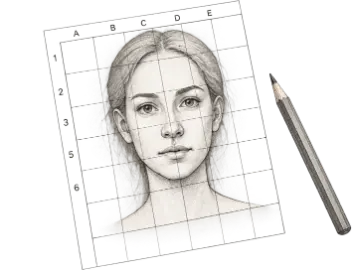
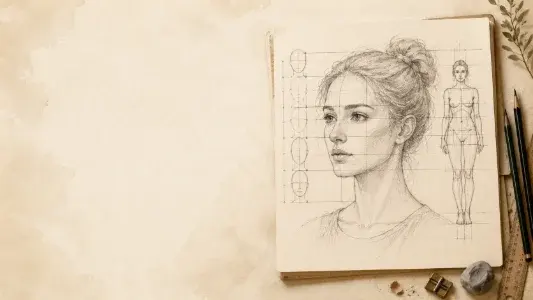
The Portrait & Figure Proportion Guide overlays established facial, head-construction, and body landmarks so artists can compare alignment while preserving the real variation of the subject.

What Is a Portrait & Figure Proportion Guide?

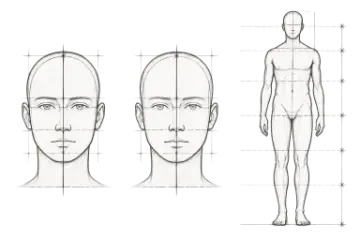
A portrait and figure proportion guide is a construction reference for comparing major anatomical landmarks. Common teaching models divide the face into vertical thirds, estimate head width in eye-widths, or describe an idealized standing figure in head-length units. These systems give artists a starting framework for placement, but they are averages and design conventions rather than measurements that every person must match.

Using Facial and Loomis Landmarks

Begin by aligning the overall skull, center line, brow, and jaw before adjusting individual features. The five-eye idea can help compare eye spacing and head width, while facial thirds provide checkpoints from hairline to brow, brow to nose, and nose to chin. A Loomis-style sphere and jaw guide supports head rotation and side-plane thinking. Once the construction is stable, compare it with the actual reference and keep the differences that create likeness.

Understanding the Eight-Head Figure Model

The eight-head figure is an idealized studio convention used to organize a tall adult figure, not a biological rule or diagnostic standard. Real bodies vary with age, pose, perspective, body type, and camera lens. Use head units to place broad landmarks and evaluate balance, then prioritize gesture, weight, foreshortening, and observation. Art Grid Maker lets you study the diagram alone or compare guides with a locally loaded reference image.

Choosing a proportion guide for the study

Use one construction system at a time, align it to the complete head or figure, and then preserve the subject's real departures from the convention.

Front-view portrait check

Facial thirds or five-eye guide · align cranium and center line · 60–75% guide opacity

Makes broad spacing differences visible without forcing every face into identical measurements.

Three-quarter head construction

Loomis guide · align sphere, side plane, brow, and jaw before features

Supports rotation and center-line thinking when the head is not facing straight forward.

Standing figure study

Eight-head guide · align top of head and supporting foot · compare shoulder, pelvis, and knee levels

Provides an idealized construction baseline while leaving gesture and body variation intact.

Works best with

  • Clear front or three-quarter references
  • Standing poses with visible major landmarks
  • Studies where the guide is used for comparison, not correction

Expect extra cleanup with

  • Extreme foreshortening without perspective adjustment
  • Wide-angle photos that visibly distort body parts
  • Applying adult studio conventions to children as fixed anatomy

Key Features

Facial Thirds

Study broad vertical relationships between the hairline, brow, nose, and chin.

Five-Eye Comparison

Use eye-width units as a starting point for head width and spacing observations.

Loomis Head Construction

Review sphere, side-plane, center-line, and jaw landmarks for rotating heads.

Eight-Head Figure

Compare an idealized standing figure with common head-unit landmarks.

Photo Underlay

Position a reference beneath the guide and check where individual proportions differ.

Printable Studio Sheet

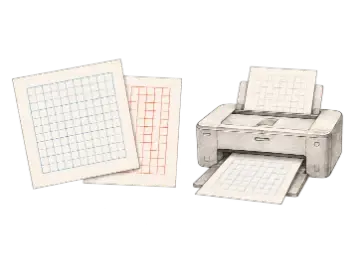
Export a high-resolution reference for sketchbooks, lessons, and offline practice.

Common proportion landmarks

Treat each landmark as an observation prompt, not a formula that should erase individual anatomy.

OptionBest for
Eye lineNear head midpoint
Five-eye modelWidth comparison
Facial thirdsVertical comparison
Eight-head figureIdealized model

How to use Free Portrait & Figure Proportion Guide

  1. Step 1

    Choose the study guide

    Select facial thirds, eye spacing, head construction, or figure-height landmarks for the subject you are analyzing.

  2. Step 2

    Align the main landmarks

    Position and scale the guide around the head or figure before judging individual features.

  3. Step 3

    Compare rather than force

    Treat standard proportions as a baseline and preserve the real differences visible in the subject.

When this tool is useful

Portrait comparison

Compare feature placement when a likeness feels off but the cause is unclear.

Figure construction

Compare gesture and body landmarks with a conventional head-height framework.

Teaching anatomy

Demonstrate common proportional starting points alongside real variation.

Frequently asked questions

What is a portrait proportion guide?
It is a construction reference that organizes common facial, skull, and figure landmarks. Artists compare those starting points with the real subject instead of treating them as measurements everyone must match.
What is the five-eye rule in portrait drawing?
It is a teaching model that compares head width at eye level with roughly five eye-width units, including approximately one eye-width between the eyes. Real faces vary, so observation takes priority.
What are the thirds of the face?
A common study divides the face from hairline to brow, brow to the base of the nose, and nose to chin. Hairlines, features, age, expression, and perspective make these distances vary.
What is the eight-head figure model?
It is an idealized studio convention that describes a tall adult figure in eight head-length units. It is useful for construction practice but is not an anatomical average or a rule for every body.
Can I compare the guides with my own photo?
Yes. Load a reference under the guide, align the broad head or figure landmarks, and use the differences to study the individual subject rather than forcing the photo into a template.
Are portrait proportion rules accurate for children and different poses?
Not without adjustment. Age, pose, foreshortening, camera lens, expression, and individual anatomy change apparent proportions. Use the guide as a baseline and draw what the reference actually shows.

Keep your studio workflow in one place

Explore proportion guides. When you need the paid workflow, unlock 300 dpi studio reference sheet.